What Types of Soulmates Exist?

When people think about soulmates, they usually imagine just one person — someone perfect, someone destined, someone who is meant to stay forever.
But if you’ve ever experienced a deep connection, you probably already felt that things are not that simple.
Because the truth is… it’s not.
The idea of a soulmate is much broader, much deeper, and much more human than most people think. It’s not limited to one person, and it doesn’t always look the way we expect. In fact, throughout life, we can meet different types of soulmates — and each one touches us in a different way, for a different reason.
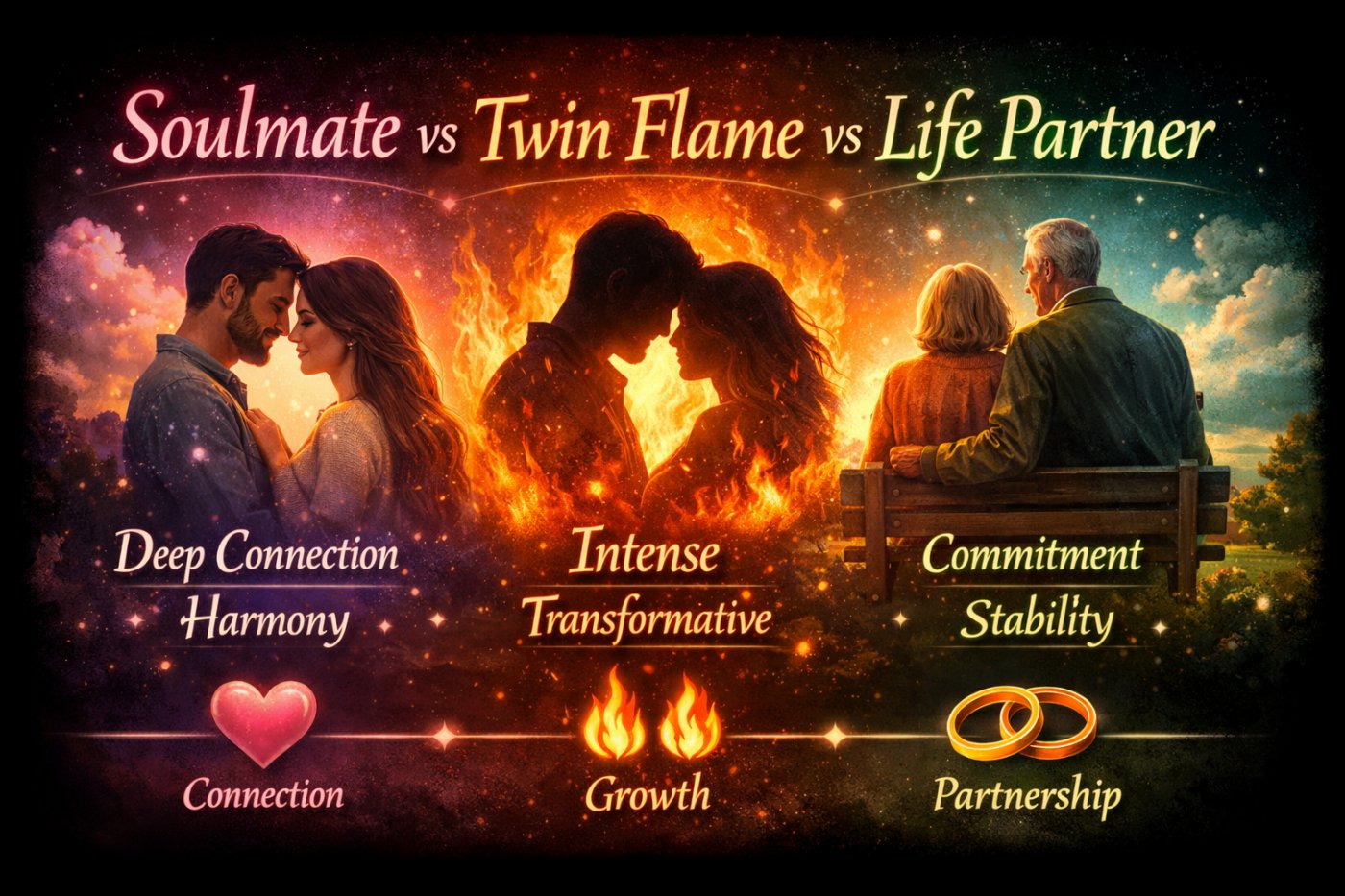
Some soulmates feel like home almost instantly. These are the romantic soulmates — the kind of connection most people are hoping to find. With them, things feel natural. You don’t feel like you have to try too hard. Conversations flow, silence is comfortable, and there’s a quiet sense of being understood without needing to explain everything.
What makes this connection special is not intensity, but alignment. It feels balanced. It feels mutual. It feels like both people are moving in the same direction.
But even this kind of connection — as beautiful as it is — is not automatically perfect. And it is not guaranteed to last forever. That’s something many people don’t want to hear, but it matters. Because even the strongest connection still needs to be built, nurtured, and protected over time.
Then there are the soulmates that don’t feel calm at all.
These are often called karmic soulmates — and if you’ve ever been in one of these connections, you know exactly how different they feel. They can be intense, overwhelming, and sometimes even confusing. You may feel deeply connected, but at the same time emotionally shaken.
These relationships tend to bring things to the surface — insecurities, fears, old emotional wounds. They can create strong attachment, sometimes to the point where it feels hard to let go, even when you know something isn’t right.
And this is where many people get confused.
Because the intensity can feel like something meaningful… like something important… like something that must be “meant to be.”
But often, what’s happening is something else.
These connections are not necessarily here to stay — they are here to teach. They show you patterns, boundaries, and parts of yourself that need attention. They can be powerful, but they are not always peaceful.
And that difference matters.
There are also soulmates who don’t come into your life as romantic partners at all.
Sometimes, the deepest connections you will ever experience come through friendship. A platonic soulmate is someone who understands you in a way that feels almost effortless. There is no pressure, no emotional confusion, no expectation beyond simply being present for each other.
With them, you feel accepted. You feel safe. You feel like you can be exactly who you are, without needing to change anything.
And in many cases, these are the connections that last the longest.
Then there are those rare moments when a soulmate becomes something more grounded — something real in a very practical sense. This is where the idea of a life partner comes in.
A life partner is not just someone you feel deeply connected to.
It’s someone you build a life with.
And that changes everything.
Because now it’s not only about feelings. It’s about choices. It’s about commitment. It’s about showing up — not just when things are easy, but especially when they are not.
This kind of relationship asks for something different. It asks for patience, communication, respect, and emotional maturity. It asks you to learn how to live together, how to deal with differences, how to grow as individuals while still growing as a couple.
And this is something many people underestimate.
Because they believe that finding the right person is enough.
But it isn’t.
Even the most beautiful connection will not survive without effort.
And sometimes, what makes a relationship truly strong is not how it starts — but how it is maintained.
You may also hear people talk about twin flame connections, and it’s very common to confuse them with soulmates. At first, they can feel very similar — deep, magnetic, almost impossible to ignore.
But the experience is very different.

A twin flame connection tends to be more intense, more unstable, and much more emotionally activating. It can feel like something you cannot escape, even when it becomes overwhelming.
These connections often bring emotional highs and lows, moments of closeness followed by distance, and a sense that something inside you is being deeply stirred.
It’s not just about love.
It’s about transformation.
And that’s why it can feel so powerful — and at the same time, so difficult.
In real life, though, things are rarely as clear as definitions suggest.
And this is where most people struggle.
Because when you’re inside a connection, emotions can blur everything. You might confuse intensity with compatibility. You might believe that strong attachment means deep alignment. You might feel something so powerful that you assume it must be your soulmate — or something even more.
But one of the most honest ways to understand what you’re experiencing is not by looking at how strong it feels in a moment…
It’s by looking at how it feels over time.
Does it bring you peace?
Or does it keep you in emotional ups and downs?
Does it make you feel safe?
Or constantly uncertain?
A harmonious soulmate connection tends to feel stable and grounding. A karmic connection often feels repetitive and emotionally exhausting. A platonic soulmate brings clarity and comfort without pressure. And a life partner becomes visible through consistency, presence, and the ability to build something real together.
And this is where many people get it wrong.
They believe that the strongest feeling must be the right one.
But intensity does not always mean compatibility.
In fact, sometimes it comes from unresolved emotional patterns — from parts of us that are still trying to heal.
And this leads to another important distinction that very few people talk about clearly: the difference between compatibility and emotional attachment.
Compatibility creates ease. It allows two people to understand each other, to grow together, to move forward without constant friction.
Attachment, on the other hand, can exist even when things are not working.
You can feel deeply attached to someone who is not right for you.
You can feel connected to someone who does not offer stability.
And this is where many people stay longer than they should — not because the relationship is healthy, but because the emotional bond feels strong.

Compatibility is real. There are people who naturally align with us more than others. They share similar values, similar ways of feeling, similar perspectives on life.
But even when this exists, something very important still remains:
A relationship needs to be built.
It doesn’t come ready.
It doesn’t sustain itself.
It is something that takes shape over time, through daily choices, through patience, through understanding, through the ability to listen, to adapt, and to respect each other’s individuality.
Being with someone does not mean losing yourself.
It means learning how to share your life while still being who you are.
And this balance is what creates something real.
In the end, what makes a relationship last is not the type of soulmate.
It is the way the relationship is lived.
It is the effort that both people are willing to make.
It is the respect they have for each other.
It is their ability to grow — not just individually, but together.
Even the strongest connection cannot survive without care.
And sometimes, even a simple connection can become something beautiful when both people choose to nurture it.
There are moments when everything feels confusing. When emotions are too strong, and clarity seems distant. And if you’ve ever been there, you know how hard it is to see things clearly when you are emotionally involved.
Sometimes, what helps is stepping back. Looking at the situation from a different perspective. Allowing yourself to understand what you are feeling without rushing to define it.
Because in the end…
The question is not how many types of soulmates exist.
The real question is:
👉 What is this connection teaching you?
Because every meaningful connection leaves something behind.
It changes the way you see love.
It changes the way you see yourself.
It changes what you are willing to accept — and what you are not.
And maybe that is the real purpose of a soulmate.
Not to complete you.
But to help you understand yourself more deeply…
and guide you, step by step, toward a more conscious, more real, and more meaningful experience of love.